
Introduction
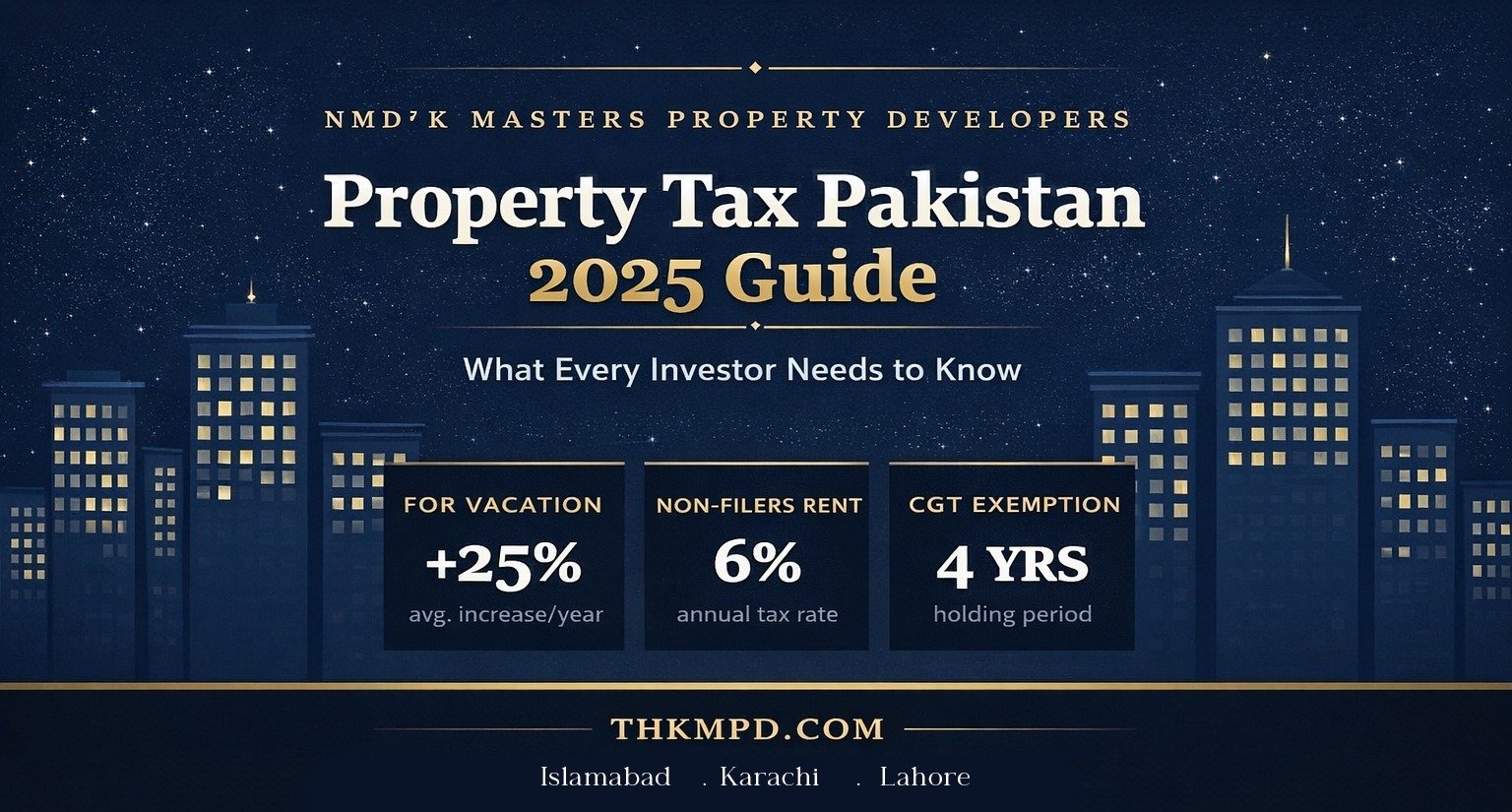
Pakistan’s real estate tax framework has undergone its most significant restructuring in years. For 2025, the Federal Board of Revenue (FBR) has introduced revised property valuation tables, tightened compliance requirements, and raised withholding tax rates — changes that directly affect every property buyer, seller, investor, and developer across the country.
Whether you are a first-time homebuyer in Lahore, an overseas Pakistani planning to invest from abroad, or a seasoned real estate developer managing a portfolio across multiple cities, understanding these changes is no longer optional. The difference between a compliant transaction and a costly penalty now comes down to how well you know the current rules.
This guide provides a clear, expert-reviewed breakdown of every major property tax change in Pakistan for 2025 — covering FBR valuation updates, withholding tax, capital gains tax, annual property tax, and city-specific implications for Lahore, Karachi, Islamabad, and Rawalpindi.
Why Pakistan's Property Tax System Changed in 2025
For decades, a well-known gap existed between official government property valuations and actual market prices. Properties in prime areas like DHA Lahore or Clifton Karachi were often registered at figures far below their real transactional value — a practice that suppressed tax revenue, enabled undisclosed wealth, and distorted the broader economy.
The 2025 reforms are a direct response to this structural problem. By aligning FBR property valuation tables more closely with market rates, the government aims to:
- Increase documented tax revenue from the real estate sector
- Reduce under-reporting of property transactions
- Create a more transparent and investor-friendly market
- Bring overseas Pakistani investment into a formally recorded system
- Support provincial governments with more accurate annual property tax assessments
The result is a tax environment that demands greater compliance but also delivers greater market credibility — a trade-off that long-term investors and institutional developers will benefit from most.
Key FBR Property Valuation Changes for 2025
The most immediate change investors will notice is the upward revision of FBR property valuation tables across all major Pakistani cities. These tables serve as the official benchmark for calculating withholding tax, capital gains tax, and stamp duty at the time of registration.
What the New Valuations Mean in Practice
Across Lahore, Karachi, Islamabad, and Rawalpindi, average FBR valuation rates have increased by 20% to 30% compared to the previous year. This means the taxable base for your property transaction — the figure from which WHT and CGT are calculated — is now significantly higher.
For example: if a property in DHA Lahore Phase 6 was previously recorded at an FBR valuation of PKR 80 lakh, its revised 2025 valuation may now stand at PKR 96 lakh to PKR 104 lakh. Your withholding tax obligation is calculated on this higher figure, regardless of the actual agreed sale price.
Before signing any property deal in 2025, always check the current FBR valuation for that specific location at fbr.gov.pk. Rates vary by locality, property type, and city zone.
This change affects all parties in a transaction — buyers, sellers, and transferring agents. Real estate developers and agents are now legally required to ensure that registered values reflect FBR-notified rates during property documentation.
Complete Guide to Pakistan's Property Tax Types in 2025
Pakistan’s real estate tax system is not a single tax — it is a layered framework of federal and provincial levies. Here is a comprehensive overview of every tax type applicable to property transactions in 2025:
| Tax Type | Who Pays | When It Applies |
|---|---|---|
Withholding Tax (WHT) |
Buyer & Seller |
At time of property registration |
Capital Gains Tax (CGT) |
Seller |
On sale within 4 years of purchase |
Annual Property Tax |
Owner |
Collected yearly by provincial authority |
Rental Income Tax |
Landlord |
On annual rental income earned |
Stamp Duty |
Buyer |
At property transfer/registration |
Withholding Tax (Advance Tax) — Section 236C & 236K
Withholding tax is the most immediately relevant levy for anyone buying or selling property. Under the Income Tax Ordinance 2001, it applies at the point of registration — meaning it is collected upfront, before the transaction is completed.
In 2025, the FBR has raised WHT rates specifically for non-filers to increase pressure on individuals not registered in the tax system. Filers generally pay lower rates, which is a strong incentive to ensure your tax filing is current before any property deal.
- Filers (active tax return filed): 3% of FBR-notified value
- Non-filers: 6% of FBR-notified value (increased in 2025)
- Both buyer and seller are liable — each pays their respective rate at registration
Capital Gains Tax (CGT)
Capital gains tax applies when you sell a property for more than you paid for it. In Pakistan, CGT is time-sensitive — the rate diminishes the longer you hold a property, eventually reaching zero after a defined holding period.
For 2025, the CGT window remains at 4 years. Properties sold within 4 years of purchase attract a CGT liability that decreases in steps across each year of ownership. Properties held for 4 or more years are exempt from CGT, making long-term investment significantly more tax-efficient.
- Year 1 of ownership: highest CGT rate applies
- Year 2–3: progressive reduction in CGT rate
- Year 4 onwards: full CGT exemption
Annual Property Tax
Annual property tax is a recurring levy collected by provincial authorities — the Excise and Taxation Department in Punjab, the Sindh Building Control Authority in Karachi, and the Capital Development Authority in Islamabad. It is based on the Annual Rental Value (ARV) of the property rather than its market price.
The ARV method estimates what your property would earn in annual rental income, and applies a tax rate to that figure. Residential properties attract lower rates than commercial or mixed-use properties, and smaller homes often qualify for ARV-based exemptions.
Rental Income Tax
If you earn income from leasing or renting property in Pakistan, that income is taxable under the Income Tax Ordinance. Rental income is added to your total annual income and taxed at the applicable slab rate. Landlords are required to declare rental income in their annual tax return — a requirement the FBR is enforcing more rigorously in 2025 through digital integration with NADRA and land registry systems.
City-by-City Property Tax Breakdown for 2025
While federal tax laws apply uniformly, the practical impact of 2025 changes varies significantly by city due to differences in valuation rates, provincial tax administration, and market dynamics.
| City | Valuation Increase | WHT (Filer) | WHT (Non-Filer) | CGT Window |
|---|---|---|---|---|
Lahore |
~25% |
3% |
6% (raised 2025) |
4 years |
Karachi |
~20% |
3% |
6% (raised 2025) |
4 years |
Islamabad |
~30% |
3% |
6% (raised 2025) |
4 years |
Rawalpindi |
~22% |
6% (raised 2025) |
3% |
4 years |
Lahore — Punjab
Lahore has seen some of the sharpest valuation revisions in 2025, with urban and semi-urban localities averaging a 25% increase in FBR-notified rates. Prime locations including DHA Lahore, Gulberg, Bahria Town, and Model Town are particularly affected, with commercial properties experiencing steeper revisions than residential ones.
The Excise and Taxation Department Punjab administers annual property tax in Lahore. Property owners can now access online tax assessment and payment portals, reducing the need for in-person visits. For investors with portfolios across multiple Lahore localities, it is critical to check each locality’s revised FBR table individually — rates are not uniform even within the same phase of a housing scheme.
Karachi — Sindh
Karachi’s 2025 property tax landscape is shaped by an important policy alignment: the Sindh Revenue Board (SRB) has now harmonised its property valuation methodology with FBR benchmarks, closing a long-standing gap that allowed Karachi transactions to be documented at lower values than their Lahore or Islamabad equivalents.
The Karachi online property tax payment system has been significantly upgraded, allowing property owners in localities from Clifton and Defence to Gulshan-e-Iqbal and North Karachi to calculate, verify, and pay their annual property tax digitally. For buyers and sellers, this increased transparency also means greater scrutiny at the time of transfer.
Islamabad — ICT
Islamabad presents a unique challenge in 2025: a persistent valuation gap between CDA (Capital Development Authority) and FBR-notified rates. The ICT administration has moved toward standardising tax rates across residential, commercial, and mixed-use categories — but in practice, properties in F-7, F-8, and E-series sectors may reflect different effective tax rates depending on which valuation authority’s figures apply to a given transaction.
For Islamabad investors, the safest approach is to obtain both the CDA valuation and the FBR-notified rate for a specific plot or property before finalising any transaction, and to confirm with a registered tax practitioner which rate governs your specific deal structure.
Rawalpindi — Punjab
Rawalpindi follows the Punjab provincial framework, with FBR valuations rising by approximately 22% in major residential areas including Bahria Town Phase 1–8, Satellite Town, and commercial zones along Murree Road. As Rawalpindi’s real estate market increasingly aligns with Islamabad’s twin-city dynamics, investors should treat cross-border property decisions (between the two cities) as requiring a dual-city tax assessment.
How to Calculate Your Property Tax Liability in 2025
Understanding your tax liability before entering a transaction protects you from unexpected costs at the registration stage. Here is a step-by-step framework applicable to most property deals in Pakistan in 2025:
- Obtain the FBR-notified valuation for your specific property location from fbr.gov.pk.
- Confirm your tax filer status — your WHT rate depends on whether you are an active filer
- Calculate WHT: multiply FBR valuation by applicable rate (3% filer / 6% non-filer) — both buyer and seller pay separately
- If selling within 4 years: calculate CGT based on your year of holding and applicable rate slab
- Use your provincial property tax portal to check your annual ARV-based property tax obligation
- Account for stamp duty and registration fees, which vary by province and property value.
Most provincial tax authorities now offer online property tax calculators. Use the official Punjab, Sindh, or ICT portal for your city — third-party calculators may use outdated rate tables.
Tax Exemptions Still Available in 2025
Despite the tightening tax environment, a meaningful set of property tax exemptions remain in force across Pakistan’s provinces. Understanding these can significantly reduce your effective tax liability.
Residential Property Exemptions
- Properties below the provincially-defined minimum size threshold (varies by province and locality)
- Owner-occupied primary residences in certain ARV brackets
- Properties in designated rural or agricultural zones outside city limits
Institutional & Social Exemptions
- Registered religious institutions — mosques, churches, temples, and shrines
- Formally registered schools, colleges, and universities
- Charitable organisations with valid SECP or provincial registration
- Government-owned properties and public utilities
Concessions for Vulnerable Individuals
Several provincial governments offer reduced annual property tax rates for widows and senior citizens above 60 years of age who own a single residential property. These concessions typically require an application to the relevant Excise and Taxation Department with supporting documentation.
Overseas Pakistani Investors — Special Provisions
Non-resident Pakistanis investing in property through official banking channels (remittances via SWIFT or Pakistan Remittance Initiative) may be eligible for facilitated tax treatment under FBR’s investor-friendly provisions. Digital payment options and verified online registration processes make it increasingly practical for overseas investors to complete compliant property transactions without being physically present in Pakistan.
Always verify current exemption eligibility with a registered tax consultant or directly through your provincial Excise and Taxation Department — exemption criteria can change with annual provincial budgets.
What These Changes Mean for Real Estate Investors and Developers
For Local Investors
The 2025 changes increase the upfront cost of property transactions through higher valuations and adjusted WHT rates. However, they also reduce the risk of future tax disputes or asset scrutiny, since properties documented at current FBR rates have a clear, compliant tax trail. Investors who have historically under-documented their property portfolios face the greatest exposure and should consider voluntary regularisation.
For Overseas Pakistani Investors
Pakistan’s real estate market remains one of the most attractive investment avenues for the diaspora — offering relatively high rental yields and long-term capital appreciation in cities like Lahore and Karachi. The 2025 reforms, particularly the push toward digital land records and NADRA-linked property registration, make remote investment considerably safer. Overseas investors should ensure their properties are registered under their CNIC/NICOP and that their tax affairs in Pakistan are managed by an authorised tax practitioner.
For Real Estate Developers and Agents
Developers and real estate agents now operate under stricter FBR obligations when facilitating property sales. Failure to register transactions at notified FBR values can result in penalties for all parties — including the agent or developer. This makes compliance not just a legal requirement but a professional obligation that directly affects your business reputation.
Developers launching new housing schemes or commercial projects should factor revised land valuation rates into their project cost models and ensure that buyer-facing documentation reflects the current regulatory environment.
For First-Time Homebuyers
If you are purchasing your first property in Pakistan in 2025, the higher FBR valuations mean your registration-stage costs — WHT, stamp duty — will be modestly higher than in previous years. However, if you are purchasing to occupy rather than to sell, your exposure to CGT is limited, and the annual property tax on a modest residential home typically remains manageable. Ensuring you are a registered tax filer before completing your purchase will reduce your WHT obligation from 6% to 3%.
Pakistan's Digital Property Tax Infrastructure in 2025
One of the most consequential long-term developments accompanying the 2025 tax changes is the accelerating digitisation of Pakistan’s real estate and tax administration systems. The government is actively integrating three major data systems:
- NADRA national identity records
- FBR tax filing and withholding tax databases
- Provincial land record authorities (Punjab Land Record Authority, Sindh Land Revenue Authority, etc.)
This integration means that property transactions are increasingly traceable and cross-referenceable. A property purchased under your CNIC is now linked to your FBR tax profile. Rental income from that property is cross-checked against declared income in your tax return. Undeclared or under-documented assets face a significantly higher risk of detection than in previous years.
For investors, this is ultimately a positive development — it creates a more transparent market, reduces the risk of fraud, and provides stronger legal protection for documented transactions. The transition period, however, requires active attention to your compliance status.
Final Perspective
Pakistan’s 2025 property tax reforms signal a structural shift — from an environment where informal documentation was routine, to one where compliance is actively enforced and digitally monitored. For investors who adapt proactively, this shift represents an opportunity: a more transparent, credible market where documented assets hold stronger legal standing and long-term value.
The practical steps are straightforward. Ensure your tax filing status is current. Verify FBR valuations before any transaction. Understand your CGT exposure based on your intended holding period. And if you manage a property portfolio across multiple cities or are investing from abroad, engage a qualified tax practitioner familiar with Pakistan’s evolving regulatory landscape.
The Pakistan real estate market — across Lahore, Karachi, Islamabad, and beyond — continues to offer compelling fundamentals for long-term investors. The 2025 reforms, while increasing near-term transaction costs, lay the foundation for a more resilient and institutionally credible property sector.
For personalised guidance on property investment, tax planning, or project development in Pakistan’s real estate market, contact the advisory team at thehmpd.com.
FBR-notified property valuations have increased by 20% to 30% across major Pakistani cities including Lahore, Karachi, Islamabad, and Rawalpindi. The exact increase varies by locality and property type. Check fbr.gov.pk for the official valuation table for your specific area.
For active tax filers, withholding tax (advance tax) is 3% of the FBR-notified property value — payable by both buyer and seller at registration. Non-filers pay 6%. This rate was increased for non-filers in 2025 as part of FBR’s compliance push.
Yes. Capital gains tax applies to properties sold within 4 years of purchase. The rate decreases progressively with each year of ownership and reaches zero after 4 years. Long-term property investors who hold assets beyond this window are fully exempt from CGT.
No. While federal taxes (WHT, CGT under the Income Tax Ordinance) apply uniformly, annual property tax is administered at the provincial level. Punjab, Sindh, KPK, and Balochistan each have their own rate structures, exemption criteria, and collection systems. Islamabad’s ICT operates under a separate framework from Punjab despite geographic proximity.


Join The Discussion