Grey Structure Cost in Lahore 2026 Complete Per Sq Ft & Material Guid
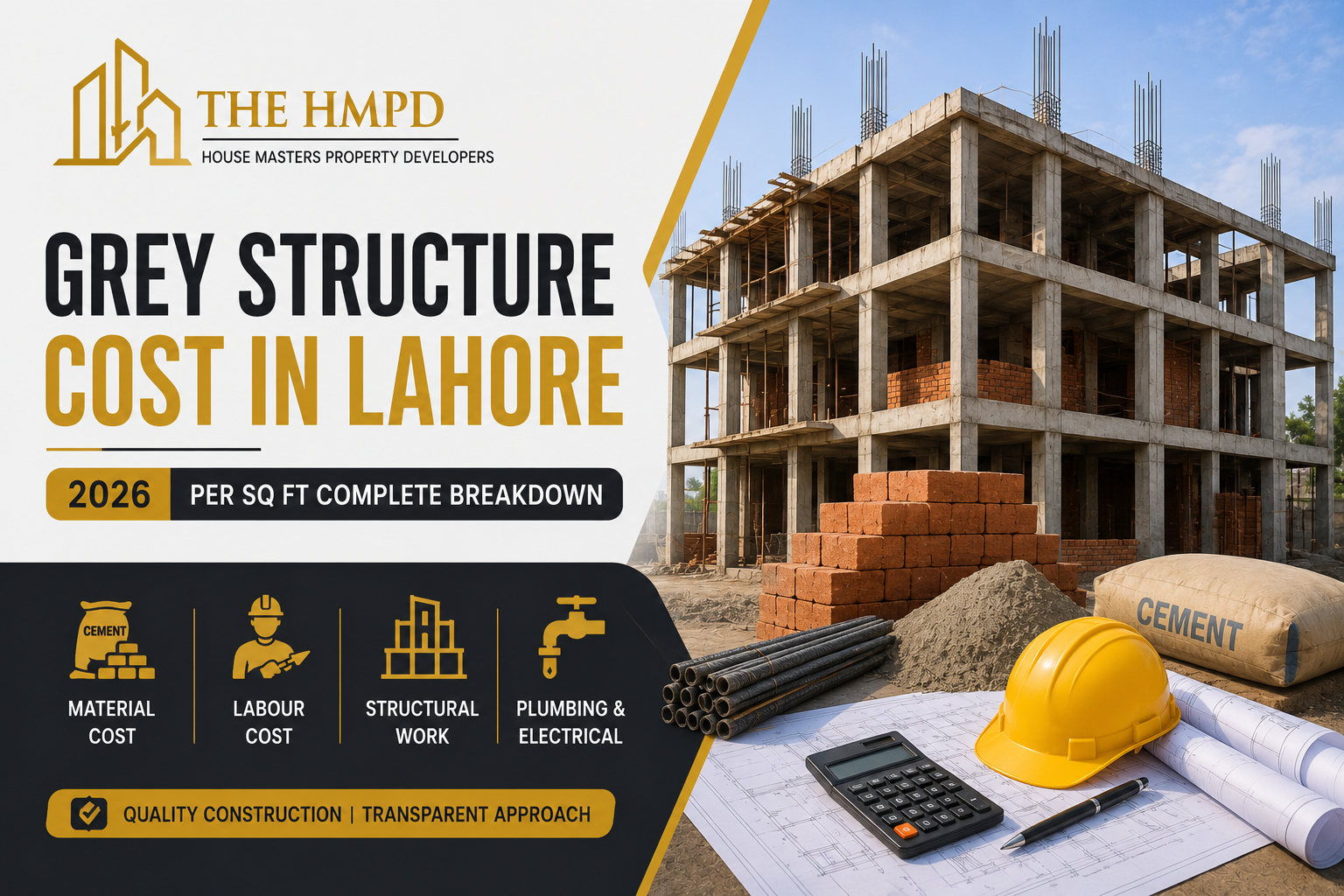
Building a house in Lahore involves several financial decisions, but one of the first major budgets homeowners need to understand is the grey structure cost in Lahore.
Whether you are constructing a 5 Marla, 10 Marla, 1 Kanal or larger residential property, the grey structure creates the basic physical framework upon which the rest of the house is built.
It generally comes before expensive finishing items such as flooring, sanitary ware, kitchen cabinets, wardrobes, decorative ceilings and paint.
However, estimating grey structure cost is not as simple as multiplying the plot size by one fixed market rate.
The actual cost depends on factors such as:
- Total covered area
- Number of floors
- Foundation requirements
- Structural design
- Steel consumption
- Cement consumption
- Brickwork
- Labour rates
- Plumbing scope
- Electrical conduits
- Waterproofing
- Material specifications
- Site conditions
- Contractor scope
This guide explains the major components affecting the grey structure construction cost in Lahore in 2026, how per-square-foot estimates work, which materials consume the budget and what homeowners should check before selecting a contractor.
What Is a Grey Structure Cost in Lahore House Construction?
A grey structure is the basic structural and semi-finished stage of a building before final decorative finishing begins.
In simple terms, it creates the shell and essential concealed infrastructure of the house.
Depending on the agreed contractor scope, grey structure work may include:
- Site preparation
- Excavation
- Foundation
- RCC work
- Columns
- Beams
- Roof slabs
- Staircase structure
- Brick masonry
- Internal plaster
- External plaster
- Roof treatment
- Concealed plumbing
- Sewerage pipes
- Electrical conduits
- Electrical boxes
- Waterproofing in agreed areas
- Underground water-related structural work where included
However, homeowners should understand one very important point:
There is no universal definition of a grey structure quotation.
One contractor may include certain plumbing or waterproofing work while another may exclude it.
This is why quotations should always be compared using a written scope and material specifications.
What Is Not Normally Considered Grey Structure?
Grey structure should not be confused with complete house construction.
Items generally associated with the finishing stage can include:
- Floor tiles
- Wall tiles
- Marble or stone finishing
- Paint
- False ceilings
- Decorative lights
- Electrical switches
- Sanitary ware
- Faucets
- Bathroom accessories
- Kitchen cabinets
- Wardrobes
- Internal decorative doors
- Aluminium windows
- Glass work
- Decorative elevation materials
- Interior features
The exact division between grey structure and finishing can vary by contract, so the written agreement remains more important than the terminology itself.
Grey Structure vs Finishing Basic Difference
| Component | Grey Structure | Finishing |
|---|---|---|
| Foundation | Included | Not Applicable |
| RCC Structure | Included | Not Applicable |
| Brick Masonry | Included | Not Applicable |
| Plaster | Generally Included | Surface finishing follows later |
| Plumbing | Concealed lines may be included | Fixtures & sanitary ware |
| Electrical | Conduits/boxes may be included | Switches, lights & fixtures |
| Flooring | Usually Not Included | Included |
| Kitchen | Structural/concealed work only | Cabinets & countertops |
| Paint | Not Included | Included |
How Is Grey Structure Cost in Lahore Calculated?
For early-stage budgeting, homeowners commonly use a per-square-foot calculation.
The basic formula is:
Estimated Grey Structure Cost = Total Covered Area × Grey Structure Rate Per Sq Ft
For example, if two houses use comparable specifications but one has significantly more covered area, the larger house will generally require more material and labour.
However, this formula should be treated as an initial construction estimate, not a guaranteed final price.
A more accurate calculation requires:
Architectural Drawings + Structural Drawings + Covered Area + Material Specifications + BOQ + Labour Scope
Plot Size Is Not the Same as Covered Area
This distinction is extremely important.
A 10 Marla plot does not mean that the grey structure cost should simply be calculated on 10 Marla of land.
The actual construction estimate is influenced by the covered area of the building.
For example, a property may contain:
- Ground floor
- First floor
- Mumty
- Porch
- Covered terrace
- Other approved constructed areas
At the same time, portions of the plot may remain open as:
- Lawn
- Setbacks
- Open terrace
- Courtyard
- Side passage
Therefore, homeowners should ask:
“What is my total covered area?”
before asking:
“What is the grey structure rate per square foot?”
Major Factors Affecting Grey Structure Cost in Lahore
The same per-square-foot rate cannot accurately represent every residential project
| Factor | Impact on Cost | Reason |
|---|---|---|
| Covered Area | Very High | More construction requires more materials and labour. |
| Foundation Design | Very High | Structural requirements affect excavation, concrete and reinforcement. |
| Steel Consumption | Very High | Reinforcement is a major structural material. |
| Cement Consumption | Very High | Cement is extensively used in RCC, masonry and plaster. |
| Number of Floors | High | Additional floors increase structural and masonry work. |
| Basement | Very High | Excavation, retaining structures and waterproofing add work. |
| Material Specifications | High | Brands, grades and specifications influence procurement cost. |
| Labour | High | Workmanship and project complexity affect labour requirements. |
| Site Conditions | Variable | Access and ground conditions can influence execution. |
Major Materials Used in Grey Structure Construction
Understanding where the money goes can help homeowners evaluate contractor quotations more intelligently.
The major materials commonly associated with residential grey structure construction include:
1. Cement
Cement is used extensively throughout the project in:
- RCC
- Concrete
- Brick masonry
- Plaster
- Screed
- Other cement-based works
Because of the quantity required, changes in cement prices can influence the overall grey structure material cost.
2. Reinforcement Steel
Steel reinforcement is a critical structural material used according to engineering requirements.
It may be required in:
- Footings
- Columns
- Beams
- Roof slabs
- Staircases
- Other RCC elements
The quantity should be based on structural drawings rather than arbitrary assumptions.
Reducing steel quantities merely to lower the construction quotation can create serious structural concerns.
3. Bricks
Bricks are another major quantity item in residential construction.
Brick quality can influence:
- Wall construction
- Mortar consumption
- Plaster requirements
- Breakage
- Material wastage
- Workmanship
A cheaper material is not necessarily economical if it creates excessive breakage or additional finishing requirements.
4. Sand
Different construction activities may require suitable types and quality of sand according to project specifications.
Sand can be used in:
- Masonry mortar
- Plaster
- Concrete-related applications
Material cleanliness and suitability should be considered alongside price.
5. Crush / Aggregate
Aggregate is an important component of concrete.
The required type, size and quantity depend on structural specifications and the intended concrete work.
6. Concrete
Concrete quality depends not only on material selection but also on:
- Mix requirements
- Batching
- Water control
- Placement
- Compaction
- Curing
Poor execution can reduce the benefit of good-quality materials.
Material Importance in Grey Structure
| Material | Main Application | Budget Importance |
|---|---|---|
| Cement | RCC, masonry, plaster & concrete work | Very High |
| Steel | Structural reinforcement | Very High |
| Bricks | Internal & external walls | High |
| Sand | Mortar, plaster & concrete work | High |
| Crush | Concrete/RCC work | High |
| Plumbing Pipes | Concealed water & drainage network | High |
| Electrical Conduits | Concealed electrical network | Medium–High |
| Waterproofing Materials | Roof and relevant wet areas | High |
Foundation Cost in Grey Structure Construction
The foundation transfers building loads safely to the ground and is therefore one of the most important stages of house construction.
Foundation-related work can involve:
- Layout
- Excavation
- Soil preparation
- Compaction
- Lean concrete where specified
- Footings
- Reinforcement
- Structural concrete
- Foundation masonry
- Damp-proofing
- Backfilling
The exact requirements depend on the structural design and site conditions.
A larger or structurally more demanding building may require a different foundation system than a simpler residence.
For this reason, foundation cost should not be estimated purely from plot size.
RCC Structure Cost
RCC means Reinforced Cement Concrete.
RCC work can account for a significant portion of the grey structure budget because it combines several cost components:
Steel + Cement + Sand + Aggregate + Shuttering + Labour
Depending on the design, RCC elements can include:
- Footings
- Columns
- Beams
- Roof slabs
- Staircases
- Lintels
- Other structural members
Proper supervision during RCC work is essential.
Why Curing Matters
Curing is an important part of concrete construction.
After concrete is placed, appropriate curing helps the material develop the performance expected from the design and mix.
Homeowners sometimes focus heavily on purchasing branded cement and steel but pay less attention to execution.
Construction quality depends on both:
Material Quality + Workmanship
Brickwork and Masonry Cost
After the main structural elements progress, masonry creates the internal and external walls of the property.
Brickwork cost can be influenced by:
- Total wall quantity
- Brick dimensions
- Brick quality
- Mortar
- Labour
- Wall thickness
- Breakage
- Material transportation
Architectural design can also influence masonry quantities.
A house containing more internal divisions may require more masonry than an open-plan design with comparable covered area.
Plaster Cost in Grey Structure
Plaster prepares walls and ceilings for later finishing work.
Its cost is influenced by:
- Surface area
- Wall alignment
- Required thickness
- Cement
- Sand
- Labour
- Workmanship
Poor masonry can sometimes require additional plaster thickness to correct uneven surfaces.
This illustrates why saving money through weak workmanship at one stage may create additional expenditure later.
Plumbing Work in Grey Structure
Plumbing is another area homeowners should understand carefully when comparing grey structure contractor quotations in Lahore.
Depending on scope, concealed plumbing can include:
- Water supply lines
- Drainage pipes
- Sewerage lines
- Kitchen plumbing provisions
- Bathroom plumbing
- Roof drainage
- Water tank connections
- Other concealed pipework
However, final sanitary fixtures such as toilets, basins, faucets and showers generally belong to the finishing stage.
Why Concealed Plumbing Quality Matters
Once tiles, paint and ceilings are completed, concealed plumbing becomes difficult to access.
A leaking concealed pipe can potentially damage:
- Walls
- Ceilings
- Paint
- Tiles
- Cabinets
- Woodwork
For this reason, plumbing quality should not be evaluated only on initial price.
Electrical Work in Grey Structure
Grey structure electrical work commonly relates to concealed infrastructure rather than final electrical accessories.
Depending on the scope, it may include:
- Conduits
- Electrical boxes
- Routes for wiring
- Distribution provisions
- AC points
- Internet/data routes
- CCTV routes
- Other concealed provisions
Final switches, sockets, decorative lights and similar fixtures usually belong to finishing.
Plan Electrical Requirements Early
Before concealed electrical work begins, homeowners should consider:
- Furniture layout
- Television locations
- Air conditioners
- Kitchen appliances
- Internet
- CCTV
- Outdoor lighting
- Solar provisions
- Backup power
- Smart-home requirements
Late electrical changes can require wall cutting and rework.
Waterproofing Cost in Grey Structure
Waterproofing is relatively easy to ignore because much of it becomes invisible after construction.
However, poor waterproofing can create expensive long-term problems.
Relevant areas can include:
- Roof
- Bathrooms
- Basement
- Water-related structural areas
- Other locations specified by the project
The exact waterproofing system should depend on the project requirements.
Labour Cost for Grey Structure in Lahore
Material cost is only one part of the total grey structure budget.
Construction requires several types of skilled and semi-skilled labour, including:
- Masons
- Steel fixers
- Shuttering workers
- Concrete workers
- Plumbers
- Electricians
- Helpers
- Supervisory staff
Labour cost can vary according to:
- Project size
- Design complexity
- Construction method
- Work duration
- Site conditions
- Labour availability
- Required workmanship
Selecting the lowest labour rate without considering quality can create false savings.
Labour Only vs Material + Labour Contract
Homeowners generally encounter different contracting approaches.
One important distinction is between a labour-only contract and a material + labour grey structure contract.
| Factor | Labour-Only Contract | Material + Labour Contract |
|---|---|---|
| Material Purchase | Homeowner | Usually contractor |
| Supplier Management | Homeowner | Usually contractor |
| Owner Involvement | Higher | Generally lower |
| Material Control | Direct owner control | Requires clear specifications |
| Procurement Time | Higher for homeowner | Usually managed by contractor |
| Quotation Comparison | Focus on labour scope | Compare both materials and scope |
Neither approach is automatically best for everyone.
The right choice depends on the homeowner’s:
- Available time
- Technical understanding
- Procurement experience
- Desired level of control
- Project-management capability
Why the Cheapest Grey Structure Quote May Not Be the Cheapest
Suppose three contractors provide three different per-square-foot quotations.
The lowest number can initially appear attractive.
However, before making a decision, ask:
- Which cement specification is included?
- What steel specification is included?
- What brick quality is assumed?
- Is plumbing included?
- Which plumbing specifications?
- Are electrical conduits included?
- Is waterproofing included?
- What type of roof treatment is included?
- What is excluded?
- How are variations handled?
A quotation is only meaningful when its scope and specifications are clear.
Importance of a BOQ for Grey Structure Construction
A Bill of Quantities (BOQ) can help break the project into measurable construction items.
A grey structure BOQ may include quantities for:
- Excavation
- Concrete
- Reinforcement
- Brickwork
- Plaster
- Waterproofing
- Plumbing
- Electrical conduits
- Other agreed works
This provides a stronger basis for:
- Budget planning
- Material procurement
- Contractor comparison
- Consumption monitoring
- Variation management
For homeowners investing substantial amounts in residential construction, a BOQ can provide far more clarity than relying solely on a verbal per-square-foot quotation.
5 Marla vs 10 Marla vs 1 Kanal Grey Structure
Plot size alone should not be used as the construction cost basis, but different house sizes can involve different project complexity.
| House Size | Cost Basis | Important Consideration |
|---|---|---|
| 5 Marla | Actual Covered Area | Efficient space planning |
| 10 Marla | Actual Covered Area | Larger structural & service requirements |
| 1 Kanal | Actual Covered Area | Greater scale and potentially higher complexity |
Does a Basement Increase Grey Structure Cost?
Yes.
A basement can substantially change the scope of grey structure construction.
Depending on the design and site conditions, additional work may include:
- Excavation
- Soil removal
- Retaining structures
- Additional reinforcement
- Additional concrete
- Waterproofing
- Drainage
- Structural walls
- Staircase
- Ventilation provisions
Therefore, a standard above-ground grey structure rate should not automatically be applied to a basement without evaluating its actual scope.
Why Site Supervision Matters
A construction budget should not focus exclusively on materials.
Even good materials can be wasted or poorly executed without appropriate supervision.
Site supervision can help monitor:
- Drawings
- Material specifications
- Steel placement
- Shuttering
- Concrete work
- Brick alignment
- Plumbing routes
- Electrical routes
- Waterproofing
- Material consumption
- Workmanship
- Construction progress
For homeowners who cannot visit the site frequently, particularly overseas Pakistanis, structured reporting and supervision can become even more important.
Grey Structure Cost Breakdown by Construction Stage
A homeowner should understand the grey structure as a sequence of interconnected construction stages rather than one single expense.
The budget moves through several major phases:
Site Preparation → Foundation → RCC Structure → Brickwork → Plumbing → Electrical → Plaster → Waterproofing → Testing
Each stage requires different materials, labour and quality-control measures.
If work performed during an early stage is incorrect, correcting it later can increase the overall grey structure cost in Lahore.
For example, poorly planned plumbing may require wall cutting, while inaccurate masonry can increase plaster requirements.
Good planning therefore helps control both direct costs and expensive rework.
Grey Structure Construction Stages
| Stage | Main Work | Major Cost Drivers | Quality Priority |
|---|---|---|---|
| Site Preparation | Layout, excavation & preparation | Labour, machinery & soil removal | High |
| Foundation | Footings & foundation structure | Steel, concrete & labour | Very High |
| RCC Structure | Columns, beams, slabs & stairs | Steel, cement, aggregate & shuttering | Very High |
| Brickwork | Internal & external walls | Bricks, mortar & labour | High |
| Plumbing | Concealed supply & drainage | Pipes, fittings & labour | Very High |
| Electrical | Conduits & concealed provisions | Conduits, boxes & labour | High |
| Plaster | Wall & ceiling preparation | Cement, sand & labour | High |
| Waterproofing | Protection of relevant areas | System, material & workmanship | Very High |
Which Components Consume Most of the Grey Structure Budget?
The exact distribution varies between projects, but several categories usually deserve particular attention.
RCC and Reinforcement
The structural framework can require substantial quantities of:
- Reinforcement steel
- Cement
- Sand
- Aggregate
- Shuttering
- Labour
The actual quantities should be determined according to the structural design.
Masonry
A house containing more internal walls can require additional:
- Bricks
- Mortar
- Labour
- Plaster
Foundation
Foundation requirements vary according to structural design and site conditions.
Labour
Labour is required throughout almost every stage, so productivity and workmanship can influence both time and cost.
Material Price Changes and Grey Structure Cost
Construction material prices do not remain permanently fixed.
Changes in the prices of major materials such as:
- Cement
- Steel
- Bricks
- Sand
- Crush
- Pipes
can influence the final grey structure construction cost in Lahore.
This is particularly important when a project extends over several months.
A quotation prepared today may not necessarily represent future procurement costs unless the contract clearly defines how price changes are handled.
Fixed Price vs Variable Price Construction Contract
Before signing an agreement, homeowners should understand whether material-price changes are absorbed by the contractor or passed to the client.
| Factor | Fixed Price | Variable Price |
|---|---|---|
| Initial Budget Clarity | Potentially Higher | Can Change |
| Material Price Changes | Depends on contract terms | May affect final cost |
| Specifications | Must be clearly defined | Must be clearly defined |
| Variations | Usually priced separately | Usually priced separately |
| Best Practice | Read escalation clauses carefully | Define pricing method clearly |
Hidden Costs in Grey Structure Construction
Homeowners commonly prepare budgets for cement, steel, bricks and labour but overlook smaller project expenses.
Collectively, these can become meaningful.
Potential hidden or secondary costs include:
- Material transportation
- Loading and unloading
- Material storage
- Temporary electricity
- Temporary water supply
- Site security
- Machinery
- Scaffolding
- Debris removal
- Soil disposal
- Site cleaning
- Material testing
- Repairs
- Additional labour
- Construction water
- Minor design changes
- Material wastage
- Price fluctuations
These expenses should be considered when preparing a realistic house grey structure cost.
Material Wastage Can Increase Construction Cost
Buying material at a competitive price does not automatically mean the project is economical.
The second question should be:
How efficiently is that material being used?
Wastage can occur through:
- Poor storage
- Incorrect handling
- Breakage
- Excessive mortar use
- Unnecessary cutting
- Rework
- Over-ordering
- Weak site control
On a large residential project, small percentages of unnecessary consumption across multiple materials can accumulate into a significant amount.
How to Reduce Material Wastage
Store Cement Correctly
Cement should be protected appropriately from moisture and poor storage conditions.
Organise Steel
Proper organisation can reduce unnecessary cutting and handling losses.
Protect Bricks
Unnecessary breakage should be minimised.
Monitor Sand and Aggregate
Open materials require proper site management.
Track Material Deliveries
Maintain basic records for major incoming materials.
Compare Consumption With BOQ
Actual consumption can be compared periodically with estimated quantities where practical.
How to Reduce Grey Structure Cost Without Compromising Quality
Reducing cost should not mean reducing structural quality.
A better strategy is to eliminate wastage, rework, poor planning and unnecessary complexity.
1. Finalise Architectural Drawings Before Construction
Changes after execution begins can be expensive.
Moving a wall may affect:
Masonry → Plumbing → Electrical → Plaster → Future Finishing
2. Complete Structural Drawings
Structural work should follow engineering requirements rather than on-site assumptions.
This also improves quantity planning.
3. Prepare a BOQ
A Bill of Quantities provides a clearer estimate of the work and materials required.
It can also help identify unusual consumption.
4. Use Clear Material Specifications
Do not simply write:
“Good-quality cement.”
Instead, specifications should be as clear as practical for the project.
The same principle applies to:
- Steel
- Bricks
- Plumbing
- Electrical conduits
- Waterproofing
5. Compare Equivalent Contractor Quotations
A lower per-square-foot rate is meaningless if the scope is smaller.
Compare:
Same Drawings + Same Scope + Same Material Specifications + Same Quality Requirements
6. Avoid Frequent Design Changes
Changes create both direct and indirect expenses.
They can also delay the project.
7. Monitor Construction Progress
Regular monitoring helps identify problems before they become expensive.
8. Buy Strategically
For major materials, compare:
- Specification
- Price
- Transportation
- Availability
- Supplier reliability
The cheapest invoice does not necessarily provide the best overall value.
Where Should You Never Compromise?
Certain areas deserve priority because repairs can become difficult after construction progresses.
Foundation
Foundation work should comply with the structural design.
Reinforcement Steel
Structural reinforcement should follow engineering specifications.
Concrete Work
Concrete quality depends on material and execution.
Waterproofing
Leakage problems can become expensive after finishing.
Concealed Plumbing
Low-quality concealed work can create future damage.
Structural Workmanship
Good materials cannot compensate for consistently poor execution.
Grey Structure Quality Checklist
| Construction Stage | What to Check | When to Check |
|---|---|---|
| Excavation | Layout and required dimensions | Before foundation work |
| Steel | Placement according to structural drawings | Before concrete |
| Shuttering | Alignment and support | Before concrete pouring |
| Concrete | Execution, compaction and curing | During & after pouring |
| Brickwork | Alignment, joints and workmanship | During masonry |
| Plumbing | Routes, joints and testing | Before concealment |
| Electrical | Conduit locations and required points | Before plaster |
| Waterproofing | Application and testing where applicable | Before covering |
| Plaster | Surface alignment and workmanship | During execution |
Common Grey Structure Construction Mistakes
1. Starting Without Complete Drawings
Incomplete drawings can create decisions and changes during construction.
2. Selecting a Contractor Only by Price
The cheapest quote may have different specifications or exclusions.
3. No Written Material Specifications
Verbal promises can create disputes later.
4. No BOQ
Without quantities, monitoring material consumption becomes more difficult.
5. Poor Material Storage
Material damage and wastage increase project cost.
6. Weak Site Supervision
Mistakes may remain unnoticed until later stages.
7. Ignoring Waterproofing
Water-related defects can become expensive after finishing.
8. Making Frequent Changes
Rework increases both labour and material consumption.
9. No Plumbing Testing
Concealed plumbing should be appropriately checked before final covering.
10. Ignoring Future Electrical Requirements
Adding new electrical points later can require cutting finished walls.
Grey Structure Construction Timeline in Lahore
There is no single completion period applicable to every house.
The timeline depends on:
- Covered area
- Number of floors
- Basement
- Structural complexity
- Labour availability
- Material supply
- Weather
- Site access
- Cash flow
- Design changes
- Approval requirements
A straightforward 5 Marla project and a large 1 Kanal residence should not automatically be expected to follow identical timelines.
A more useful approach is to monitor progress by construction milestones.
Grey Structure Project Flow
Planning
Drawings, BOQ and specifications
Excavation
Site layout and foundation preparation
Foundation
Structural foundation work
RCC Structure
Columns, beams, slabs and stairs
Brickwork
Internal and external masonry
MEP Rough-In
Plumbing and electrical provisions
Plaster
Wall and ceiling preparation
Inspection
Testing and grey structure review
Grey Structure vs Turnkey Construction in Lahore
Grey structure and turnkey construction are not the same service.
With a grey structure contract, the project generally stops before major finishing work.
A turnkey construction contract can continue through agreed finishing and final project completion.
Grey Structure vs Turnkey
| Factor | Grey Structure | Turnkey Construction |
|---|---|---|
| Structural Work | Included as agreed | Included |
| Major Finishing | Generally excluded | Included as agreed |
| Kitchen | Concealed/basic provisions | Can include complete kitchen |
| Bathrooms | Concealed plumbing | Can include complete finishing |
| Flooring | Generally excluded | Can be included |
| Paint | Generally excluded | Can be included |
| Owner Finishing Control | Higher after structure | Defined through contract |
| Overall Scope | Limited | More comprehensive |
Labour Contract or Complete Grey Structure Contract Which Is Better?
There is no universal answer.
A labour-only contract can suit homeowners who:
- Understand material procurement
- Have time to manage suppliers
- Can monitor quantities
- Want direct control over purchases
A complete material + labour contract can suit homeowners who:
- Have limited time
- Prefer centralised project management
- Want the contractor to coordinate procurement
- Are comfortable with clearly defined material specifications
The quality of the agreement and supervision matters in either model.
How to Choose a Grey Structure Contractor in Lahore
Before hiring a grey structure contractor in Lahore, evaluate more than the quoted rate.
Check:
- Previous projects
- Relevant construction experience
- Structural execution
- Site supervision
- Material specifications
- BOQ
- Written scope
- Exclusions
- Payment schedule
- Construction milestones
- Quality-control process
- Variation policy
- Communication process
- Handover procedure
Is the Lowest Grey Structure Rate in Lahore the Best Deal?
Not necessarily.
Consider two hypothetical quotations:
Contractor A: Lower per-square-foot rate
Contractor B: Higher per-square-foot rate
If Contractor B includes better-defined materials, waterproofing, plumbing provisions, stronger supervision and a broader scope, comparing only the final rates would be misleading.
The correct comparison is:
Price + Specifications + Scope + Workmanship + Supervision + Exclusions
rather than price alone.
Grey Structure Cost for 5 Marla, 10 Marla and 1 Kanal Houses
Homeowners searching for more size-specific budgeting information should also review the dedicated THE HMPD construction guides.
5 Marla House Construction Cost in Lahore
10 Marla House Construction Cost in Lahore
1 Kanal House Construction Cost in Lahore
This helps users move from a general grey structure guide to information closer to their own project size.
It also creates a strong topical relationship between your construction articles and main Construction Services in Lahore page.
Why Choose THE HMPD for Grey Structure Construction in Lahore?
Grey structure construction requires coordination between architecture, structural engineering, material procurement, labour and site supervision.
THE HMPD House Masters Property Developers provides professional construction services in Lahore for homeowners and property investors.
Depending on project requirements, the construction process can include:
- Construction planning
- Grey structure construction
- Material coordination
- BOQ-based planning
- Site supervision
- Quality monitoring
- Construction progress management
- Turnkey construction
- Finishing coordination
- Project handover
For homeowners and overseas Pakistanis who cannot remain at the construction site every day, organised project supervision and progress monitoring can also improve visibility throughout the construction process.
Construction Services in Lahore
Final Verdict Grey Structure Cost in Lahore 2026
The grey structure cost in Lahore cannot be accurately judged by one universal per-square-foot figure.
The final cost depends on:
Covered Area + Structural Design + Foundation + Steel + Cement + Bricks + Sand + Crush + Labour + Plumbing + Electrical + Waterproofing + Contractor Scope
A per-square-foot rate is useful for preparing an initial construction budget.
But before signing a contract, homeowners should move beyond the rate and examine:
- Architectural drawings
- Structural drawings
- BOQ
- Material specifications
- Scope of work
- Exclusions
- Payment milestones
- Quality-control procedures
The lowest quotation is not automatically the most economical option.
A cheap grey structure that requires repeated repairs, additional material, structural corrections or extensive rework can eventually become more expensive.
A better construction strategy is:
Plan Properly → Define Specifications → Prepare BOQ → Compare Contractors → Monitor Materials → Supervise Execution → Test Concealed Work
Homeowners should prioritise structural quality and concealed work while controlling cost through efficient design, material management and reduced wastage.
Ultimately, the goal should not simply be to achieve the lowest grey structure rate in Lahore.
The better objective is to achieve the right balance between:
Construction Cost + Structural Quality + Material Control + Workmanship + Long-Term Durability
Planning Grey Structure Construction in Lahore?
If you are planning a 5 Marla, 10 Marla, 1 Kanal or customised residential project in Lahore, THE HMPD can help with grey structure planning, construction management, site supervision and turnkey construction.
Questions to Ask Before Signing a Grey Structure Contract
Before hiring a grey structure contractor in Lahore, clarify the scope, materials, payments, quality control and variation policy in writing.
The contractor should clearly list every item included in the quoted rate, such as excavation, foundation, RCC work, brick masonry, plaster, concealed plumbing, electrical conduits, waterproofing and other agreed structural works. A written scope makes contractor quotations easier to compare.
Ask for a written exclusion list. Items such as tiles, sanitary ware, paint, doors, windows, kitchen cabinets, wardrobes, lighting fixtures, external works or certain utility-related expenses may be excluded depending on the contract.
The agreement should identify the required cement specification or approved brands rather than using vague wording such as “good quality cement.” The contractor should also explain how equivalent substitutions, if required, will be approved.
The steel specification should follow the structural drawings and agreed engineering requirements. The contract should clearly identify the applicable grade, approved source or specification and should not rely on arbitrary reductions in reinforcement simply to lower cost.
Clarify the type and quality of bricks included in the quotation. Brick quality can affect masonry alignment, mortar consumption, breakage and plaster requirements, so this specification should not be left unclear.
Ask which water supply, drainage and sewerage pipes, fittings and brands or specifications are included. The quotation should also clarify whether concealed plumbing testing is part of the contractor's responsibility.
Confirm whether electrical conduits, boxes and concealed routes are included. Also ask whether the quotation covers only conduit work or includes any wiring, because final switches, sockets and fixtures usually belong to the finishing stage.
The contract should state which areas receive waterproofing, what system or material specification is used and whether testing is included. Roofs, bathrooms, basements and other water-exposed areas may require different treatments.
Ask whether the quotation includes roof slope preparation, waterproofing, insulation or other specified roof treatment. The exact system should be written in the contract so there is no confusion at the final grey structure stage.
This depends on whether the agreement is labour-only or material plus labour. The contract should clearly state who purchases cement, steel, bricks, sand, crush, plumbing materials and other items, as well as who approves substitutions.
Transportation and handling charges should be clearly assigned in the contract. Ask whether material delivery, loading, unloading, soil removal and other logistics are included in the quoted rate or charged separately.
The contract should explain whether the rate is fixed, adjustable or subject to a material escalation clause. It should also state how changes in cement, steel or other major material prices are calculated and documented.
Variations should be approved before additional work begins. The contract should explain how extra quantities, design changes and new work are measured and priced so that unexpected charges do not appear later.
A clear payment schedule should be linked to agreed construction milestones rather than relying only on verbal requests. The contract should state advance payments, stage payments, retention if applicable and the conditions for final payment.
Ask who will supervise the project, how often inspections will take place and how structural work, steel placement, concrete, brickwork, plumbing, electrical conduits and waterproofing will be checked. Quality-control responsibilities should be clearly defined before construction begins.

Our Services
Contact
41k, Block K, Gulberg 3, Lahore, Pakistan
P: 0324 2827883
E: info@thehmpd.com