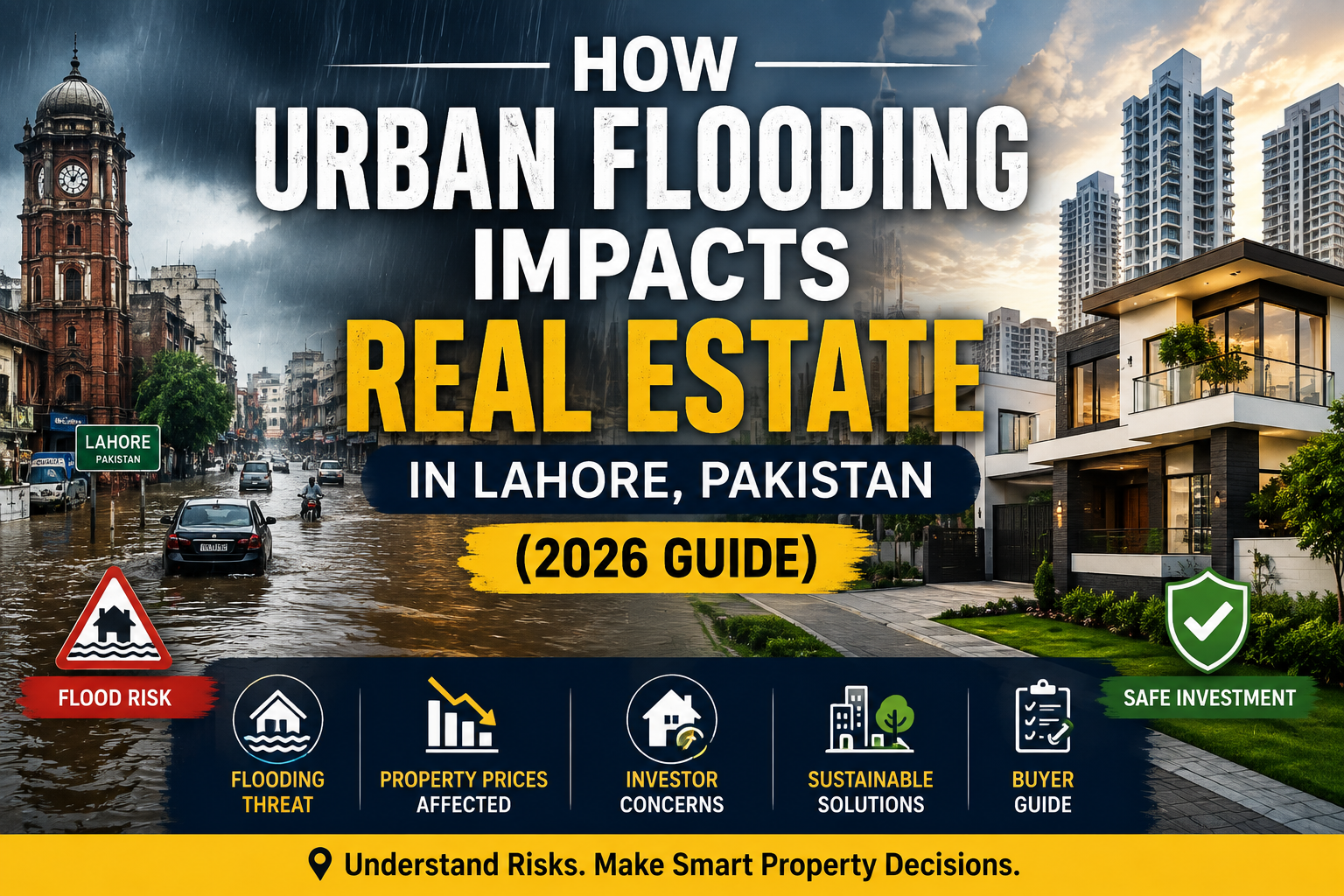
The Growing City Exploding
Flooding of the City The high rate of urbanization in Lahore has turned it into a place of prospects, learning, and civilization. This growth has however had its cost. The emergence of housing societies, commercial plazas and high rises have started to redefine not only the skyline of the city but also the equilibrium of the environment in this city.
Urban flooding has become one of the most urgent problems Lahore has to deal with nowadays. What used to be a seasonal inconvenience turned out to be a repeat crisis that hurts property, destroys lives, and reveals vulnerabilities of the existing infrastructure.
Why This Matters
Urban flooding is no longer just an environmental issue. It has become one of the biggest economic and real estate challenges in Pakistan. Buyers, developers, investors, and homeowners are now paying closer attention to flood risks before making property decisions.
Urban Flooding An anthropogenic Disaster
Destruction of the Natural Flow Systems and Green Land
The real cause of the urban flooding is not the heavy precipitation but the organized annihilation of green land. The agricultural lands, forests and open areas have served as natural absorbing areas. These plots enabled the infiltration of rainwater into the soil, and hence, a balance in urban hydrology.
Nonetheless, as it is rapidly being developed:
- Housing societies
- Commercial plots
- High-rise buildings
Concrete surfaces on these natural systems have been substituted. Flats and plots are currently obstructing the natural routes of water, which compels it to stagnate on roads and in residential places.
Major Causes of Urban Flooding in Lahore
- Illegal construction over natural drains
- Encroachment on waterways
- Rapid urbanization
- Lack of rainwater harvesting
- Poor drainage maintenance
- Climate change
- Loss of green belts
- Excessive concrete development
Trees and Environmental Impact Trees cut
Trees are important in the control of water. They also absorb excess water in their roots and prevent soil erosion. This is a natural defense going away with the mass cutting of trees in Lahore.
This has accelerated:
- Water discharge in the cities.
- Soil degradation
- Greater susceptibility to floods
This ecological irresponsibility is indicative of a larger climate reckoning, where people are actually causing disasters related to climate.
How Flooding Affects Property Value
- Houses lose resale value
- Insurance cost increases
- Repair expenses increase
- Investors avoid flood-prone locations
- Rental demand decreases
- Infrastructure damage reduces buyer confidence
Infrastructure Problems and Policy shortfalls
Lack of Government Planning
Lack of proper urban planning is one of the major causes of the urban flooding. Lahore has old drainage systems which cannot meet the larger water demand due to the high rate of urbanization.
There is:
- None of the long-term climate resilience plans.
- Little emphasis on sustainable development.
- Weak implementation of building code.
The policies have been biased towards big sized developments and elite housing schemes without considering the demands of the middle and low-income groups.
Emergence of Horizontal Growth and Vertical Growth
The city is being developed horizontally (new housing societies) and vertically (high-rise buildings). Although this increase is an indication of economic advancement, it also:
- Growth of population density.
- Strains infrastructure.
- Decreases previous land areas.
Unless this is properly planned out, this expansion aggravates flooding and makes the city less able to cope with the stresses of the environment.
What Is Inflation and How It Affects Real Estate
Property and real estate are other areas directly affected by urban flooding.
Increasing Prices and market volatility.
Flooding destroys infrastructure, roads and houses resulting in:
- A rise in construction and maintenance expenses.
- Higher insurance premiums
- Less investor confidence in some locations.
Simultaneously, the economic instability combined with environmental risks increases inflation, which in turn increases the prices of property pushing it out of reach.
Investment Change of Focus
The population is highly investing in plots and properties instead of sustainable solutions to living. This speculative behavior:
- Motivates unnatural price gains.
- Fosters excessive development.
- Disregards the impact on the environment.
Opportunities and Migration into Education
Cities as Citadels of Learning
The educational opportunities for girls and boys in modern cities such as Lahore are better. Access to:
- Universities
- Colleges
- Professional institutes
This has caused a large-scale rural to urban migration of the population.
Such a shift is a positive one as far as the level of literacy and empowerment is concerned, particularly in the female population.
Impact on Population Growth
Nevertheless, this migration too raises the population density in the cities and exerts pressure on:
- Housing
- Infrastructure
- Water management systems
The number of individuals flocking into urban areas in search of education and improved livelihoods keeps increasing, consequently driving the growth of cities.
Reduction of Agriculture and Food Security Risks
Agricultural Land Transformation
The economy of Pakistan depends heavily on agricultural activity and it is estimated that almost 60 percent of the population is linked with farming and cultivation. But fertile land is being fast changed into housing societies and commercial developments.
This has resulted in:
- Wastage of agricultural productivity.
- Limited production of local food.
- Greater reliance on foreign areas.
- Reliance on Foreign Food Shipment.
The cities such as Lahore now depend on food sources of regions such as:
This dependence results in creating a weak system. In case of a disruption of transportation, possibly only one day of disruption, the deficit of food in the city may be enormous.
A Growing Food Crisis
This is a dangerous imbalance caused by the concentration on real estate as opposed to agriculture:
- More land for housing
- Reduced area of food production.
This rings about a very important question:
What would be the worth of property when the most basic needs, such as food, will be in short supply?
Flooding in Cities and Climate Change
Lahore urban flooding is also strongly related to global climate change.
Changing Weather Patterns
Rainfall patterns are not predictable and extreme weather cases are on the increase. This together with bad urban planning results in:
- Sudden flooding
- Waterlogging
- Infrastructure collapse
- Lack of Climate Resilience
Cities are forced to keep up with these changes through developing climate resilience. The present day development practices in Lahore, however, do not correspond to the principles of sustainability.
The Hidden Cost: Lahore’s Real Estate vs. Food Security
While urban flooding is a visible crisis, the “Silent Reckoning” lies in the destruction of Lahore’s peri-urban agriculture. According to data from the Pakistan Bureau of Statistics (PBS), nearly 60% of the national workforce is tied to the agricultural sector, yet Lahore’s fertile “Green Belts” are being converted into concrete housing societies at an unprecedented rate.
1. From "Breadbasket" to "Importer"
Historically, the outskirts of Lahore provided a steady supply of dairy and seasonal produce. Today, rapid horizontal expansion has forced the city to rely on long-distance supply chains from:
Southern Punjab (Multan & Bahawalpur): For staples and grains.
Central Punjab (Sialkot & Gujranwala): For specialized produce.
Sindh: For off-season vegetables and fruits.
2. The 24-Hour Supply Chain Vulnerability
This geographic shift has created a fragile “Just-in-Time” food system. During major urban flooding events, critical transit routes (like the M-2 Motorway or National Highway) often face closures.
Expert Insight: In a high-density city like Lahore, a 24-hour disruption in transportation can lead to immediate food shortages and predatory price hikes, turning an environmental disaster into a humanitarian one.
3. The "Speculation" Paradox
The current real estate model prioritizes speculative plot trading over sustainable land use. This behavior creates “dead capital”—land that is neither producing food nor housing people, but is effectively sealed under concrete, contributing to the urban heat island effect and worsening flood runoff.
Global Models: The Sponge City Concept
The innovation in urban planning has been adopted in countries such as Japan and South Korea.
The Sponge City Model
The concept of the sponge city is concentrated on:
- Green space absorption of rain water.
- Building with permeable materials.
- Rehabilitating natural ecosystems.
This will minimize flooding and better water management.
Movement toward Small-scale Living
In countries like:
* Japan
* South Korea
there is a growing trend of tiny house ,Compact living spaces. These solutions:
- Reduce carbon footprints
- Lower infrastructure costs
- Promote sustainable living
By comparison, the interest of Pakistan is still on large houses and luxury developments that do not cater to the needs of the environment and society.
The Way Forward: The Balancing of Growth and Sustainability
Reclaiming Green Spaces
In order to deal with urban flooding, Lahore should:
- Conserve the left agricultural land.
- Replant trees
- Create parks and green belts
Improving Urban Planning
Government policies should:
- Focus on inclusive housing
- Enhance drainage infrastructure.
- Encourage sustainable construction.
Promoting responsible Investment
Investors and developers need to change their short-term profit motive into long-term sustainability. This includes:
- Eco-friendly housing
- Smart urban design
- Balanced land use
A Turning Point of Criticality
Lahore is at a cross road. The decisions of today will define whether it will become a sustainable and resilient city or it will still grapple with the environmental and social problems. Urban flooding is not an occurrence of a natural disaster only, but an expression of human choice. Since the green land was destroyed, as well as agriculture was abandoned and the real estate growth was unregulated, the effects are now unimaginable.
To proceed, it will be necessary to have a change in attitude:
Just as expansion to sustainability.
- Between profit and responsibility.
- From concrete to nature
Then only will Lahore be able to break its existing troubles and create a future, which does not merely exist in the present, but is also habitable.