
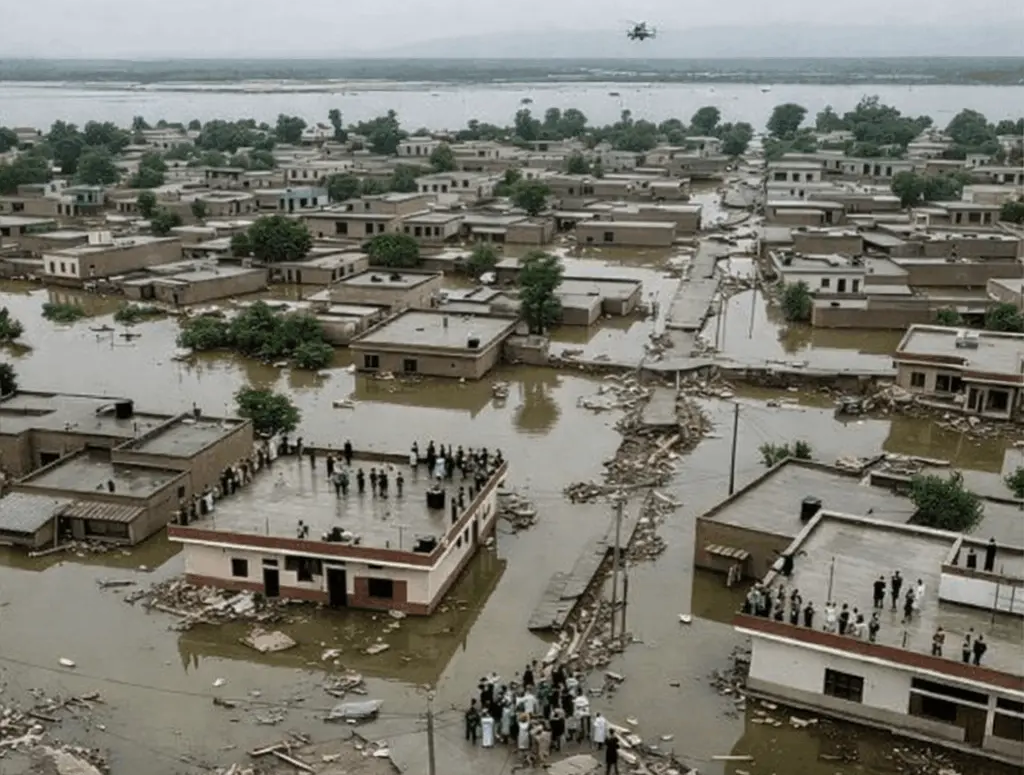
A reality-based guide to navigating construction challenges, urban development risks, and smart property decisions in Lahore’s evolving market.
A mission of transparency
House Masters Pakistan has never compromised its mission: to educate and mentor clients so they can make intelligent, secure property choices. Severe floods and heavy rains in recent years have directly disrupted the construction industry, delayed development schedules, and created uncertainty across the real estate market.
At the same time, large-scale projects like the Ravi Urban Development Authority (RUDA) have brought both hope and serious concern. This article covers the ground reality — including construction crises, urban planning failures, and practical investment guidance.
Construction crisis: sand shortage and quality risks
Flooding in the Ravi basin has directly disrupted the construction supply chain, with sand — the backbone of any structural project — at the center of the crisis.
- Supply chain disruptions: Government restrictions on riverbed mining during flood seasons have caused a critical shortage of Ravi sand. This forced many developers to source materials through unofficial channels, often at significantly inflated costs. Heavy machinery was also restricted in areas like Raiwind, further complicating logistics.
- The quality trap: Scarcity has pushed low-grade sand into the market — materials mixed with clay, gravel, and debris. This is not a minor inconvenience; it has measurable structural consequences.
- Structural impact: Using impure sand leads to poor plaster finishing, increased cement consumption, and reduced longevity of buildings. Construction timelines have extended well beyond original projections, and delivery commitments have been compromised.
House Masters Pakistan urges all investors and homeowners to prioritize material testing before proceeding with grey-structure construction. An upcoming podcast will cover how to identify and select the correct grade of sand for different structural uses.
Understanding LDA and RUDA
The Lahore Development Authority (LDA) has long been responsible for regulating construction and development in Lahore — granting NOCs, overseeing legal property procedures, and ensuring urban development follows planning standards. However, the landscape has shifted significantly with the introduction of RUDA.
Launched in 2019, the Ravi Urban Development Authority (RUDA) was presented as an ambitious project to transform Lahore’s riverfront: restoring the Ravi River, creating modern housing communities along its banks, and managing floods through engineered canals. It was envisioned as a contemporary riverfront city combining infrastructure, sustainability, and real estate development.
Important: The RUDA project has faced serious legal challenges. The Lahore High Court declared certain aspects of the project illegal, and the project currently remains under a stay order. No significant hearings have taken place in recent years. Investors must treat RUDA-area projects with caution and verify current NOC and legal status independently before making any commitment.
Earlier development plans for the Ravi River date back to before 2013, with foreign consultants including Minehart engaged for feasibility studies. Research from 2013 to 2016 explored pollution control and ecosystem restoration — but these plans were ultimately rejected as too costly, unfeasible, or environmentally problematic. The current uncertainties around RUDA reflect this longer history of unresolved challenges.
Case study: flood risk vs. infrastructure investment (Park View City)
Projects like Park View City Lahore illustrate the real tension between luxury development and natural floodplain risks. Developers have committed significant capital — reportedly around 100 crore — toward bridges, large parks, and protective infrastructure to improve lifestyle and mitigate risks.
However, infrastructure upgrades do not eliminate the underlying geographical risk. When a project is situated in a high-risk zone, extreme climate events can still cause recurring damage and financial loss. Poor site selection and the absence of long-term environmental planning remain the root problems that no amount of embankment spending can fully resolve.
Investors considering such projects must weigh currently discounted rates against long-term environmental sustainability. Lower price points in flood-prone blocks reflect real risk — not just a buying opportunity.
Investment outlook: risk vs. opportunity
Floods have directly suppressed property prices and reduced investor confidence in affected regions. The market in 2025–2026 is no longer driven by quick flips — it demands due diligence. The approach for any investor should depend on their financial position, risk appetite, and investment horizon.
| Investment factor | High-risk zones (unapproved) | LDA approved zones |
|---|---|---|
|
Market value |
Highly volatile |
More stable |
|
Legal security |
Subject to stay orders and disputes |
Verified NOC and transfer rights |
|
Infrastructure |
Vulnerable to flood damage |
Planned drainage systems |
|
Price point |
Lower — reflects real risk |
Higher — reflects legal certainty |
|
Who should consider |
High risk appetite only |
Recommended for end-users |
Investors with the capacity to hold long-term may see recovery in affected areas. Those needing liquidity should carefully consider exit conditions before entering. Reduced prices create genuine opportunities — but only for those who have done their homework on legal approvals, flood history, and construction quality.
Flooding: planning failure or nature?
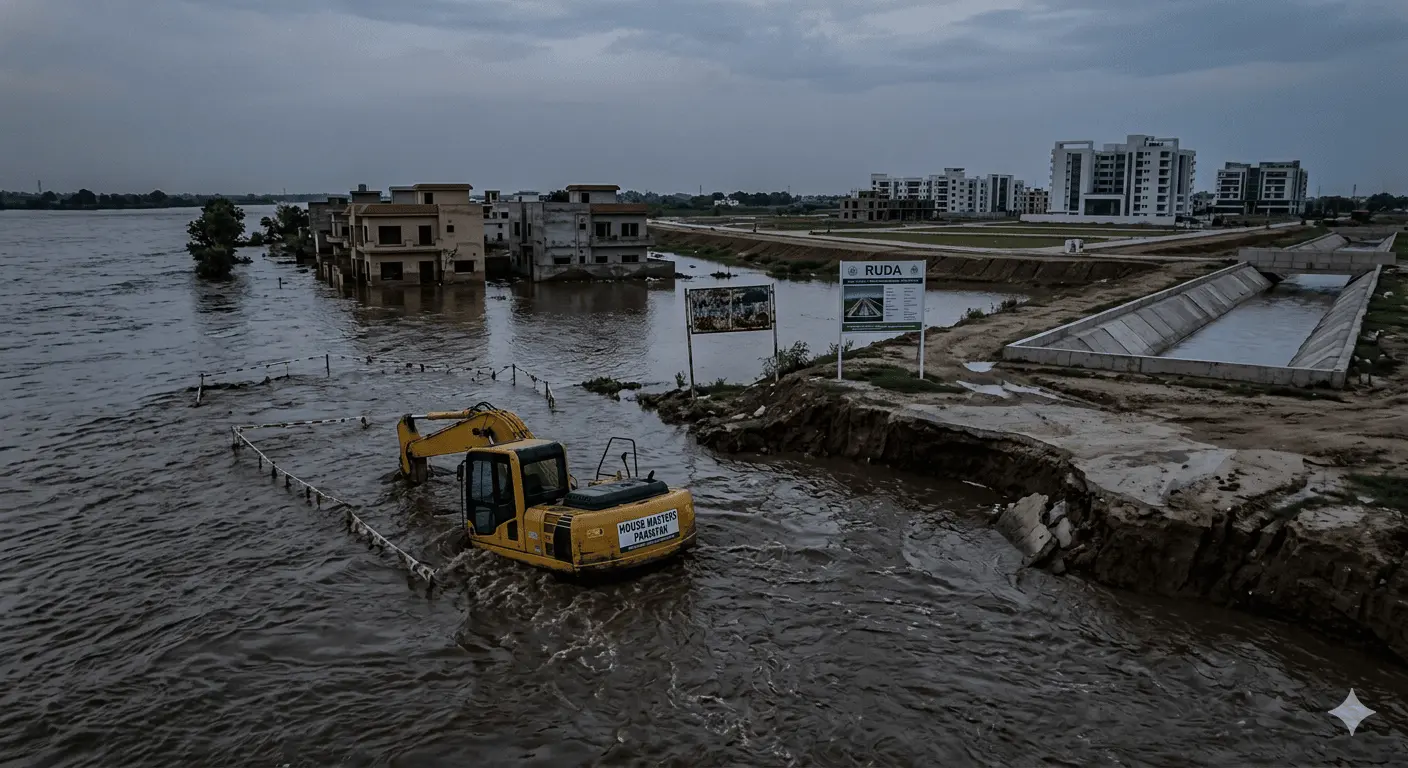
Flooding in Pakistan is caused by both natural and man-made factors. External triggers include heavy rainfall and water releases from India. Internal problems — poor urban planning, absence of effective drainage, and neglect of historic flood patterns — compound the damage significantly.
Climate change is no longer a distant concern. Rainfall patterns have become increasingly unpredictable, and storm intensity is rising. Pakistan is experiencing severe effects of global warming despite contributing very little to global carbon emissions. These trends make wiser urban planning not optional but urgent.
LDA and RUDA must coordinate far more effectively to ensure that new housing schemes are not just profitable, but genuinely climate-resilient. Environmental impact assessments, correct zoning, and long-term infrastructure planning must become standard practice — not afterthoughts.
Final Thoughts
House Masters Pakistan is determined to lead people in a transparent fashion. Floods and challenges in policy have brought uncertainty, but have also highlighted some key deficiencies in planning and decision making.
The interview between Dr. Umar Khan and Tabish Mujahid raise the truth of the issue concerning large-scale development projects and the necessity of awareness and due diligence.
Real estate is not only the process of buying and selling, it is also the knowledge of the risks, market timing, and sustainability.
FAQs
RUDA is a development authority tasked with redeveloping the Ravi River corridor and creating modern urban infrastructure in Lahore. It matters because many housing schemes are being marketed under its umbrella. However, it currently operates under a Lahore High Court stay order, making legal due diligence essential before investing in any RUDA-associated project.
Government restrictions on riverbed mining during flood seasons have reduced supply. Combined with restrictions on heavy machinery in key areas and additional taxation, a significant supply-demand gap has formed — slowing projects, raising costs, and pushing lower-quality material into the market.
Impure sand mixed with clay, gravel, and debris results in weak plaster, rough finishing, excessive cement use, and reduced structural longevity. It ultimately increases building costs and compromises the long-term safety and durability of construction.
It depends on legal approvals, site planning, and individual risk analysis. Discounted prices in such areas reflect real risk — not necessarily a bargain. Investors must take time to research flood history, check NOC status, and assess infrastructure quality before committing.
House Masters Pakistan is committed to transparent, honest, and reality-based real estate guidance. Real estate is not just about buying and selling — it is about understanding risk, market timing, legal safety, and sustainability. For more insights, professional discussions, and intelligent property advice, stay connected with us.



Join The Discussion